2026 Electric Vehicle Tax Credits Explained [+ EV Tax Credit Calculator]
The federal EV tax credit has been repealed. If you buy an electric vehicle now, there is no federal credit.
The One Big Beautiful Bill Act, signed in July 2025, terminated the clean vehicle credits for any vehicle acquired after September 30, 2025. That covers all three:
- The $7,500 new clean vehicle credit (IRC 30D)
- The $4,000 used clean vehicle credit (IRC 25E)
- The commercial clean vehicle credit (IRC 45W)
The cut-off is the date you took delivery, not the date you ordered. Signing a contract or paying a deposit before September 30, 2025 does not preserve the credit if the car arrived afterwards.
If you bought before the cut-off, you can still claim it on the tax return for the year you took delivery, using IRS Form 8936. The eligibility rules described further down this page apply to those purchases.
If you are buying now, state and utility incentives are the only help left. Several states still offer meaningful money and they are listed further down. Note that some states also charge EV owners an annual fee, which in a few cases now exceeds $250 a year.
The rest of this page describes the federal credit as it operated up to September 30, 2025, and is kept for anyone filing for an earlier purchase.
This is the only calculator that determines qualifying federal and state-level EV incentives based on:
- the very latest government regulations (released in April 2023)
- changing, real-time data on qualifying manufacturers, models, and incentives in all 50 states
- whether you are eligible based on your specific purchase and income requirements
Electric Vehicle Tax Credit Calculator
You can also view specific details on the Federal EV Tax Credit at fueleconomy.gov. However, always consult a tax professional to review your specific tax situation and confirm eligibility.
The EV tax credit offered up to $7,500 per consumer for vehicles acquired on or before September 30, 2025. It is no longer available for purchases after that date.
Understanding the EV Tax Credit (Video)
Want to learn more about EVs beyond just tax credit savings? Check out our YouTube course to see if an electric vehicle is right for you >>
How Does the EV Tax Credit Work?
This section describes the credit as it worked for vehicles acquired on or before September 30, 2025. It has since been repealed and is not available for later purchases. The federal programme offered a maximum credit of $7,500 on a qualifying EV, depending on your personal circumstances. The type of vehicle you choose and your tax burden impact how much of the federal incentive you can access. Additionally, the vehicle you buy must have a battery with a capacity of at least 7 kWh, along with meeting other criteria.
Qualifying electric, hydrogen, and plug-in hybrid vehicles placed into service from 2023 onwards are eligible for the federal tax credit for new clean vehicle purchases. A separate tax credit of up to $4,000 is in place for purchases of used clean energy vehicles sold for less than $25,000.
Since the incentive is not a tax rebate yet, you can claim only as much credit as your tax liability in that year. This is expected to change in 2024, but currently, the amount you save depends on your tax burden.
Eligibility Requirements
There are some key qualifying criteria that vehicles must meet for different aspects of the federal tax credit. For a vehicle to be eligible, it must:
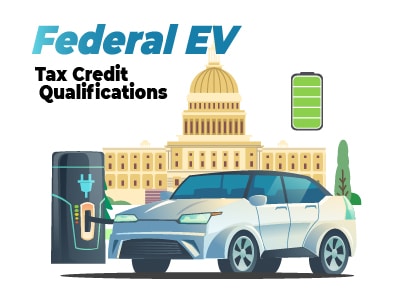
- Be assembled in North America
- Be made by a qualified manufacturer and meet minimum sourcing requirements for battery components and critical minerals
- Charge from an external source.
- Contain a battery pack with a capacity of 7 kilowatt hours (kWh) or more.
- Be 100% battery-electric or have a plug-in hybrid drive train.
- Be intended primarily for use on US roads.
- Earn below set income thresholds.
EV Tax Credit Income Limits
The federal tax credit for electric vehicles is only available to buyers earning below its income qualification caps. Note that the income limits are different depending on whether you are buying a new EV or a used one.
Following updates in 2023, the current EV tax credit income limits for buying a new and used electric vehicle are as follows:
| Married Couples (Filing Jointly) | ||
| Head of Households | ||
| All Other Filers |
How to Claim the $7,500 EV Tax Credit (Purchases Before October 2025 Only)
The list of electric vehicles qualifying for the new federal EV incentives is constantly updated. Manufacturers add new models and shift production to North America. Use our EV incentive calculator above to find the latest qualifying models and check if your chosen EV is eligible.
Since the federal EV incentive is a tax credit, you do not get it immediately upon purchasing the EV. You apply for the EV federal tax credit when filing your taxes for the year you bought the vehicle. For instance, if you buy a new EV in May 2023, apply for the credit with your 2023 taxes in early 2024.
You must fill out IRS Form 8936 when filing your annual income tax returns. Keep in mind that not all online or software-based tax systems support this form.
Get Your EV Questions Answered
Thinking about buying an electric car or truck but intimidated by all the jargon?
– Where can you charge on the road?
– What do you need to charge at home?
– What EV incentives are available in your state?
Does the EV Tax Credit Apply to Used Cars?
A separate incentive from the new clean vehicle federal tax credit exists for used EV purchases. This provides qualifying buyers with a credit of up to $4,000 when purchasing a used EV priced below $25,000.
For a used EV to qualify for this credit, it must:
- Be purchased on or after January 1, 2023
- Be purchased for personal use, not resale
- Be more than two years older than the current model year
- Have a gross vehicle weight rating below 14,000 lbs
- Have a battery capacity of at least 7 kWh
- Be sold via a licensed dealership
- Not have already claimed a used EV tax credit
Does the EV Tax Credit Apply to Leased Cars?
Only the vehicle’s titleholder can claim the EV tax credit. While leasing an EV is great for the environment and allows you to upgrade to newer technology every few years, you will not be able to claim the EV tax credit directly. Some lenders will factor in the tax credit to the monthly payment calculations, which would allow you to absorb some of the benefit of the tax credit in the form of lower monthly payments.
State EV Tax Credits
In addition to the federal tax credit, electric vehicles may also qualify for local and state incentives. Of course, the amount and type of incentives available to you depend on the programs offered in your state. State incentives used to stack with the federal credit for combined savings of around $12,500. With the federal credit repealed, the state programme is now all you get.
Some of the potential incentives you can get from your state or local government include:
- Grants
- Tax incentives
- Loans and leases
- Rebates
- Exemptions
- Utility discounts
- Discounts on home charging equipment
You should check for your local incentives before purchasing the EV to make sure you know all of your options and the qualification requirements for each of the incentives. While the federal tax credit does not apply when leasing vehicles, some state incentives do. For example, Colorado offers up to a $5,000 tax credit for the purchase or lease of a new EV.
How to Claim Your State’s EV Tax Credit
Each state has its own EV incentives and process. The incentives and process can vary drastically among states, so be sure to research how to claim the EV state incentive for your state.
How to Claim the California EV Rebate
California offers several incentives, including a $7,000 grant based on income eligibility, a $1,500 California Clean Fuel Reward, discounted charging rates during off-peak hours, rebates for level 2 installation, and free charging for one year based on region.
Due to California EV rebates’ high cost and popularity, they installed an income limit of $150,000 for an individual or $300,000 for joint filers. Plug-in hybrids with electric ranges under 35 miles or EVs with a base price above $60,000 are not eligible. The California rebate is cash or a check at the point of sale. A mailed check may take up to 18 months to arrive.
To learn more about the process and apply for a rebate, head to California’s Clean Vehicle Rebate page.
Charging Infrastructure Incentives
Some utility companies and communities also provide EV incentives. Purchasing an electric car may earn you cash back, credits, or a discounted rate plan. In states like Arizona, California, and Hawaii, electric companies offer EV owners reduced rates based on time of use. If you join their programs and share data from your charging devices, some utilities offer discounts on home EV charging equipment.
Buying an EV is a great investment for your wallet and our planet. Various incentives help reduce the initial cost of buying an electric vehicle. Before purchasing an EV, use the above resources to determine all federal, state, and local incentives you qualify for.
EV Tax Credits, Incentives, & Rebates by State
Look below to find your state’s EV tax calculator and available local and utility incentives.
| State | State Incentives | Utility Incentives |
|---|---|---|
| Alabama | No emissions testing required | Grants for EVSE installation Discounted rate if charging between 9PM – 5AM Plug-In Electric Vehicle (PEV) Charging Rate Incentive |
| Alaska | Discounted charging rate during off-peak hours | |
| Arizona | Reduced Vehicle License Tax and carpool lane access | Reduced electricity rates based on time-of-use |
| Arkansas | No emissions testing required Up to $1,000 tax credit to switch | |
| California | $7,000 grant (based on income eligibility) $1,500 California Clean Fuel Reward | Discounted charging rate during off-peak hours Rebates for Level 2 installation and free charging for one year based on region |
| Colorado | Income tax credit of $2,500 for purchase or conversion; $1,500 for lease No emissions testing required 25% Fuel Reduction Technology Tax Credit | Offers funding for up to 80% of EVSE Up to $35,000 per EVSE |
| Connecticut | Rebate between $500 and $3,000 No emissions testing required Free metered parking in New Haven | Up to $600 rebate for Level 2 EVSE |
| Delaware | UP $3,500 rebate for purchase/lease of BEV, and $1,500 for PHEV New Battery Electric Vehicles Rebate $2,500 | $200 one-time credit and $5/month to not charge during peak hours Up $500 rebate for Level 1 or 2 charger installation |
| Florida | N/A | N/A |
| Georgia | Eligible for HOV and HOT lanes | Discounted charging rate from 11PM – 7AM Rebate for Level 2 EVSE installation |
| Hawaii | Eligible for HOV lanes No emissions testing required Free parking at state and municipal garages and in metered stalls | Discounted charging rate during off-peak hours $500 rebate for Level 2 EVSE |
| Idaho | No emissions testing required | 50% of project costs, up to $7,500 per site for Level 1 or 2 EVSE |
| Illinois | Reduced registration fee and no emissions testing required | Discounted charging rate during off-peak hours |
| Indiana | No emissions testing required | Discounted charging rate during off-peak hours Indiana & Michigan Power offers a $500 enrollment incentive for off-peak charging |
| Iowa | No emissions testing required | Rebate for Level 2 EVSE Plug-In Electric Vehicle (PEV) Fee |
| Kansas | No emissions testing required | |
| Kentucky | No emissions testing required | |
| Louisiana | Tax credit of 10% of vehicle cost, up to $2,500 No emissions testing required | $250 rebate for Level 2 EVSE |
| Maine | Up to $2,000 rebate | Discounted charging rate during off-peak hours |
| Maryland | One-time tax credit up to $3,000 Eligible for HOV lane | Discounted charging rate during off-peak hours Rebates for Level 2 EVSE and options to lease |
| Massachusetts | No emissions testing required $2,500 rebate for new vehicles with a purchase price under $50,000 | $8/month credit for off-peak hours $250 rebate for Level 2 EVSE Provides grants for 60% of the cost of Level 1 or Level 2 EVSE installed at MUDs, up to $50,000 per street address. |
| Michigan | No emissions testing required | Discounted charging rate during off-peak hours Up to $500 to install Level 2 EVSE |
| Minnesota | No emissions testing required | Discounted charging rate during off-peak hours Free charging from wind energy $500 rebate for Level 2 EVSE |
| Mississippi | No emissions testing required | $250 rebate for Level 2 EVSE |
| Missouri | No emissions testing required; $78.50 annual fee | |
| Montana | No emissions testing required Up to $1,000 tax credit to switch | |
| Nebraska | Lower interest rate loans | Rebates for Level 2 EVSE |
| Nevada | Eligible for HOV lanes No emissions testing required Free metered parking | Discounted charging rate during off-peak hours |
| New Hampshire | $1,000 rebate for purchase/lease | Discounted charging rate during off-peak hours |
| New Jersey | Up to $5,000 rebate on purchase/lease Sales tax and emission testing exemption Discounted tolls | |
| New Mexico | No emissions testing required | |
| New York | Up to $2,000 rebate No emissions testing required Discounted tolls | Discounted charging rate during off-peak hours |
| North Carolina | Discounted charging rate during off-peak hours Rebates for Level 2 EVSE |
|
| North Dakota | ||
| Ohio | No emissions testing required after one-time inspection | Lease program for Level 2 EVSE |
| Oklahoma | 75% cost reduction on alternative fuel vehicle | |
| Oregon | Up to $2,500 rebate to replace or new purchase | Discounted charging rate during off-peak hours $500 rebate for Level 2 EVSE |
| Pennsylvania | Up to $1,500 rebate | Lease program for Level 2 EVSE |
| Rhode Island | Rebates to purchase/lease No emissions testing required | |
| South Carolina | ||
| South Dakota | No emissions testing required | |
| Tennessee | No emissions testing required | $400 rebate for Level 2 EVSE |
| Texas | N/A | N/A |
| Utah | $200 rebate for one year | |
| Vermont | Up to $5,000 incentive Low or no interest loans No emissions testing required | Discounted charging rate during off-peak hours depending on region Rebates for Level 2 EVSE installation |
| Virginia | No emissions testing required $2,500 rebate | |
| Washington | Sales tax exemption No emission testing required; $100 registration fee | Tax credit for 50% of costs of home charging installation, up to $1,000 |
| West Virginia | No emissions testing required | Lease program for Level 2 EVSE |
| Wisconsin | No emissions testing required | Discounted charging rate during off-peak hours Alliant Energy is offering a $500 rebate for EV home charging installation |
| Wyoming | No emissions testing required; annual $50 fee | $5,000 rebate for businesses installing EVSE |
Qualified Electric Vehicles
The list below reflects vehicles that qualified before the credit was repealed. Eligibility was based on the vehicle’s assembly location and the components of its battery pack. It is retained for anyone filing for a purchase made on or before September 30, 2025.
The federal tax credit only reduces your tax liability. For example, even if a vehicle qualifies for the full $7,500 and you owe $5,000 in taxes, it will only credit the $5,000. You will not receive the rest of the credit of $2,500.
| Make | Model | Amount |
|---|---|---|
| Cadillac | Lyriq | Up to $7,500 |
| Chevrolet | Bolt EUV | Up to $7,500 |
| Chevrolet | Bolt EV | Up to $7,500 |
| Ford | E-Transit | Up to $3,750 |
| Ford | F-150 Lightning | Up to $7,500 |
| Ford | Mustang Mach-E | Up to $3,750 |
| GMC | Hummer EV | Up to $7,500 |
| Lucid | Air | Up to $7,500 |
| Rivian | R1S | Up to $3,750 |
| Rivian | R1T | Up to $3,750 |
| Tesla | Model 3 Performance | Up to $7,500 |
| Tesla | Model 3 LR | Up to $7,500 |
| Tesla | Model 3 SR | Up to $7,500 |
| Tesla | Model Y | Up to $7,500 |
| Tesla | Model Y Performance | Up to $7,500 |
| Tesla | Model S | Up to $7,500 |
| Tesla | Model X | Up to $7,500 |
| Volkswagen | ID.4 | Up to $7,500 |
Qualified Plug-in Hybrid Vehicles
If a PHEV meets the same requirements as described above for battery electric vehicles (BEV) and has a pack capacity of more than 7 kWh, it may qualify for the full federal tax credit of $7,500
Used our incentive calculator to find out if the PHEV model that you are considering is among those that qualify.
| Make | Model | Amount |
|---|---|---|
| Chrysler | Pacficia | Up to $7,500 |
| Ford | Escape | Up to $3,750 |
| Jeep | Grand Cherokee 4xe | Up to $3,750 |
| Jeep | Wrangler 4xe | Up to $3,750 |
| Lincoln | Aviator Grand Touring | Up to $7,500 |
| Lincoln | Corsair Grand Touring | Up to $3,750 |
Get Your EV Questions Answered
Thinking about buying an electric car or truck but intimidated by all the jargon?
– Where can you charge on the road?
– What do you need to charge at home?
– What EV incentives are available in your state?